

Choosing the right Clienteling solution can make a significant difference in customer experience and their perception of your brand. The best solutions enable seamless, personalized interactions across multiple touchpoints: whether in-store, online, via SMS, email, or social media. The goal is to engage customers at the right moment with relevant, contextualized communication.
As the industry continues to evolve at a rapid pace, it has become imperative for retailers to understand what features really make a difference in their ability to act on their selling opportunities. AI is entering the clienteling space, with features that effectively remove the barriers between a good strategy and its concrete implementation. In this article, we will look at how clienteling features and customer trends are evolving.
Shoppers love live chat and messaging
When it comes to delivering quick assistance to customers, live chat and messaging options on an e-commerce site have become part of every generation’s reflex to seek help through those channels, according to a recent McKinsey study.
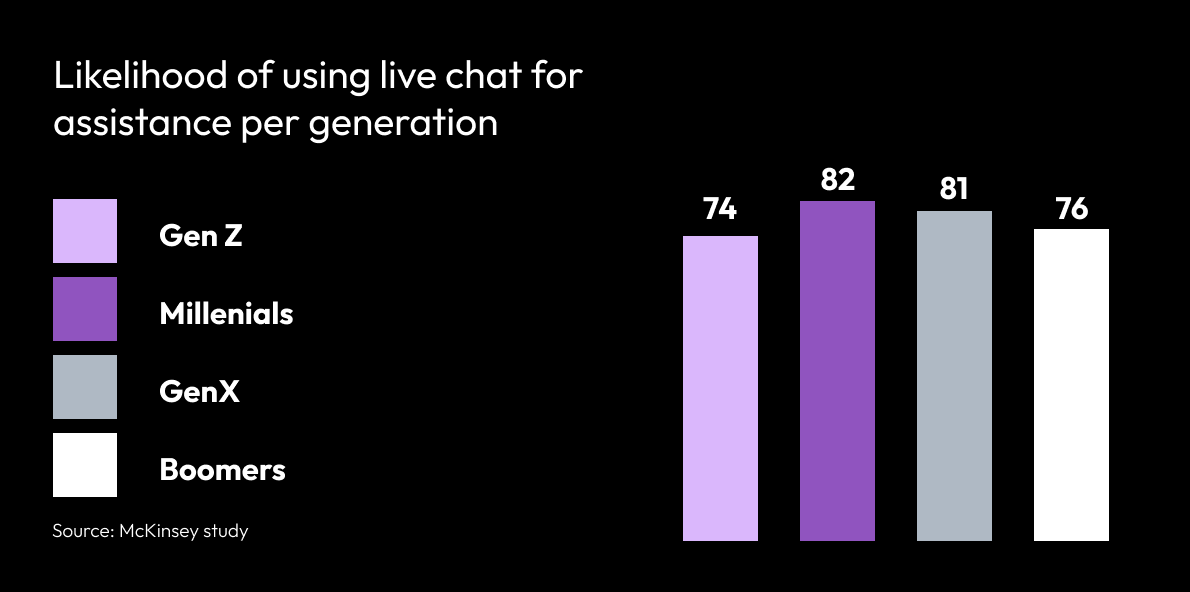
On this graphic, we can see that the likelihood of consumers engaging through live chats and text messaging was around 78% on average, for all generations combined. According to Forrester, customers who engage through live chat are 2.8X more likely to buy than those who don’t. More than ever, we are seeing a shift in consumer behavior, with consumers increasingly expecting instant answers. AI has fundamentally changed what shoppers expect. With instant answers now available at any moment, patience is no longer a given and retailers who can’t keep up are losing sales.
Email is not dead
Email is not the preferred method for quick answers, but it remains an integral part of a good customer service and retention strategy.
Although email communications have traditionally been managed by marketing departments, there is now an expectation for individual stores or sales managers to respond to client inquiries and send personalized offers directly to customers.
This shift aligns with the growing emphasis on personalized customer experiences, which have been shown to yield significant benefits. For instance, companies that implement personalization at scale often see a lift in total sales, primarily by enhancing loyalty and increasing share-of-wallet among already-loyal customers. Managing emails through the same clienteling software as other engagement channels will also allow retailers to have a better overview of their customers’ preferences and past interactions. Moreover, according to our customer exclusive data, the average open rate for a clienteling communication is on average 2X superior to the ones coming from a generic marketing communication.
NEW in clienteling: CRM capabilities
Campaigns and segmentation has long been used in a marketing context. The next step in clienteling is to leverage these capabilities and apply them at the store-level. These new capabilities will allow brands to roll out more effectively company-wide campaigns and strategies at the store-level, while optimizing its performance by allowing a greater personalization at scale.
Getting a clear perspective with smart reporting & analytics
When selecting the right software, it’s crucial to ensure it includes a robust reporting feature. In the retail industry, having a detailed overview of multiple stores’ operations enables retailers to adapt to demand, assess the effectiveness of their clienteling strategy, and identify potential blind spots when issues arise. An effective clienteling software should provide retailers with comprehensive tracking of key performance indicators (KPIs), outreach insights, and sales associates’ proactiveness, all within a single platform. Here are the essential KPIs it should track, divided in 4 categories:

Customer Service
- Request Reply Time
- Outstanding requests
- Answer rate

Customer engagement
- Scheduled Appointments
- Number of Transactions
- Conversion Rate
- Average order value
- Customer Requests:
- Appointments, video calls, live chats, SMS
- Information about sessions (duration, cancellations)
- Retailer Referred Shoppers
- Storefronts (recommendations, CTR, Views)
- Unique visitors
- New arrivals CTR
- Top picks

User Engagement
(Sales associate)
- Requests answer rates
- Communications sent (email, video calls, live chats)
- Events created
- Lookbooks created
- Tasks (number of tasks created, completed, resolve time)
- Availability rate

Connect Module
- Click rate
- Number of views
- Desktop versus mobile and tablet usage
This tracking system will ensure a detailed dashboard for managers and head office directors on all clienteling operations from the floor level all the way up to the regional and national level. It will measure the implementation of all the company’s initiatives in terms of customer engagement, customer loyalty, stores’ sales attributed to clienteling activities and more.
Bridging the online gap with Storefronts
With today’s overwhelming number of product choices, many consumers turn to social media influencers and experts for guidance before making a purchase. Digital storefronts bridge the gap between social media and traditional e-commerce experience for consumers, by allowing brands to recreate an engaging, social-media-like experience, but with greater control over product recommendations, keeping customers on their own website rather than directing them to third-party platforms. With many big names such as Macy’s, Saks Fifth, Best Buy, Shein and more using this feature with success, it is predictable that digital Storfronts will continue to grow in popularity in the years to come.
Leveraging Customer Boards to inspire
Customer boards are product display web pages specifically built for VIP clients. They work similarly to Storefronts, by allowing sales experts to recommend products to shoppers and allows customers to request appointments with a sales associate, chat or send SMS through that web page. But the main difference is that instead of displaying the sales associate’s top picks, it is a platform that caters to the customer’s personal taste or interests. These can act as an easy way to reconnect and recommend seasonal products to already known customers, allowing retailers to boost their engagement and likelihood of repeat purchases for a specific user.
From auto-tasking to AI tasking
Employee task management features are important tools when it comes to clienteling. It enables companies to assign and track in-store tasks efficiently. It distributes responsibilities such as handling appointments, making follow-up calls, and more. This improves accountability and helps ensure that important actions, such as notifying a customer about a product arrival or returning a call to a shopper seeking expert advice, are not overlooked. This feature also helps head office directors to oversee in detail how their clienteling operations are concretely being applied in every store, thus preventing a disconnect between the perception of the office worker and the sales floor reality. This tool is rapidly evolving from automation to AI, data-driven. This ensures that the tasks are distributed from data-backed insights. It can help sales associates know when to communicate with a customer and on what channel to maximize their chances of converting the outreach into a sale.
Beyond communication, robust analytics and AI task management features provide retailers with the insights and structure needed to optimize performance at every level, from individual sales associates to national operations. As client expectations continue to evolve, investing in a comprehensive, data-driven clienteling solution isn’t just an advantage, it’s a necessity for staying competitive in the modern retail landscape.
By leveraging these essential features, retailers can enhance customer engagement, improve retention, and drive revenue growth, all while delivering the seamless, high-touch experiences today’s shoppers demand.
If you are interested to see how Salesfloor can help you get a competitive edge by implementing Clienteling solutions to your business strategies, don’t hesitate to book a free 1-1 session with our in-house experts.

About the author


Genevieve Fortin has spent a decade immersed in the SaaS industry, where she developed deep expertise in customer dynamics. As a writer specializing in consumer behaviour, engagement strategies, personalization, and clienteling, she helps companies navigate the evolving landscape of customer experience and relationship-building.